Choosing the wrong lock for your front door is a mistake that could cost you far more than a replacement. Yet thousands of London homeowners live with poorly matched or outdated locks simply because nobody has ever explained the difference. Whether you own a Victorian terrace in Islington, a modern flat in Canary Wharf, or a converted property in Brixton, understanding the mortice lock vs cylinder lock debate is one of the most practical steps you can take towards better home security.
At N1 Locksmiths, we assess, install, and upgrade both lock types across every London borough, every day of the week. This guide gives you the honest, jargon-free information you need to make the right call for your property.
The Core Difference: How Each Lock Actually Works
Before comparing security ratings, it helps to understand what each lock actually does inside your door.
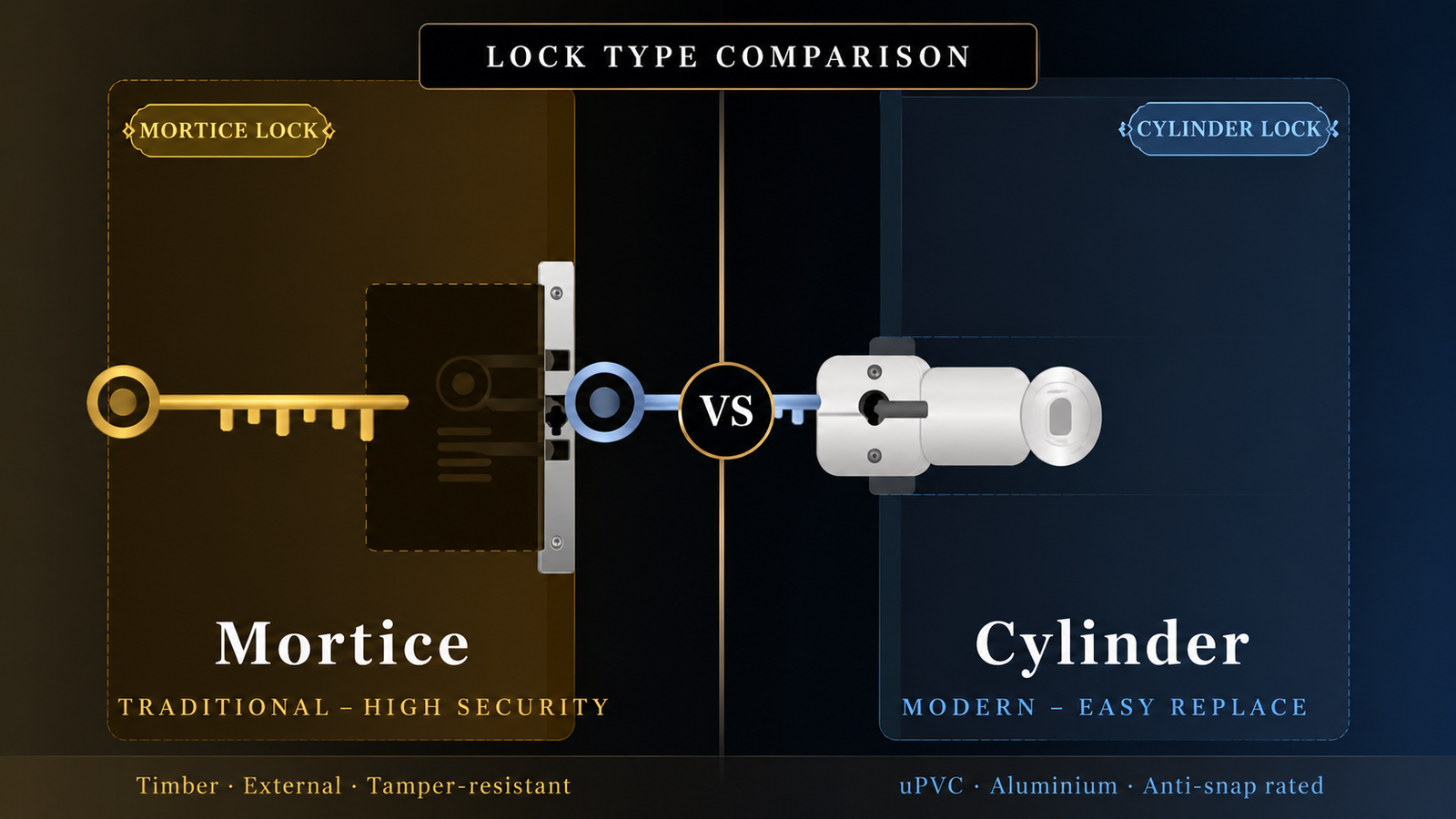
A mortice lock is set directly into a pocket — or mortice — cut into the body of the door itself. The entire locking mechanism lives inside the door, hidden from view and protected by the surrounding timber. Because of this, mortice locks are almost exclusively fitted to solid wooden doors. The most common version in the UK is the 5-lever mortice deadlock, and when it carries BS3621 British Standard certification, it is widely accepted by home insurers as a robust security measure.
A cylinder lock, by contrast, works via a removable barrel that sits within the door face. Turning the key rotates this barrel, which in turn activates the locking points inside the door. On most modern uPVC and composite doors, the cylinder connects to a multi-point locking system — a mechanism that engages multiple bolts along the full height of the door frame simultaneously. This is why you often have to lift the handle before locking a uPVC door.
Neither is universally better than the other. What matters is matching the right lock to the right door.
What Makes a Mortice Lock a Strong Security Choice?
Mortice locks have been protecting British homes for well over a century, and with good reason. Because the mechanism is entirely embedded within the door, it is far harder to attack from the outside. There is no exposed cylinder to snap, grip, or drill through. The only vulnerable point is the keyhole itself — and even this is protected on quality locks by hardened steel inserts.
Why BS3621 Matters for Mortice Locks
If your mortice lock carries the BS3621 British Standard kite mark, it has passed independent testing against the most common forced-entry techniques, including:
- Picking
- Drilling
- Cylinder pulling
- Bolt sawing
- Key bumping
More importantly, BS3621-certified mortice locks are specifically required by many home insurance policies. If your front door lock does not meet this standard, you may unknowingly be invalidating your cover. Our local locksmith London team checks this routinely during security assessments — and the results often surprise homeowners.
When Is a Mortice Lock the Right Choice?
A mortice lock is the correct option when your door is:
- A solid timber front or back door
- Part of a period property or Victorian/Edwardian terraced house
- A wooden door on a rental property or HMO
- Any external door where the frame allows for deep installation
If your wooden door is currently secured by a basic Yale-style nightlatch alone, adding a 5-lever mortice deadlock is one of the most effective security upgrades you can make. Our residential locksmith services team fits these across all London postcodes, typically within the same day you call.
What Makes a Cylinder Lock the Right Fit for Modern Doors?
Walk down any London street built in the last 25 years and you will see cylinder locks on almost every front door. The widespread adoption of uPVC and composite doors in new-build and refurbished properties has made the euro cylinder lock the dominant locking mechanism in urban residential settings.
The cylinder format suits these doors because the locking action — rotating the barrel — is perfectly designed to activate multi-point systems. When it works properly, a single key turn engages bolts at the top, middle, and bottom of the door frame. That is a significant barrier to kick-in attacks and shoulder barges.
The Anti-Snap Revolution
Older euro cylinder locks had a serious vulnerability: they could be snapped in half using a technique that takes fewer than 30 seconds and requires only basic tools widely available online. Lock snapping became one of the most common burglary methods in the UK during the 2010s.
The response from the security industry was the development of anti-snap cylinder locks, which are now the recognised minimum standard for any cylinder lock on an external door. These locks are engineered to break at a sacrificial point that leaves the core locking mechanism intact — making snapping completely ineffective.
When choosing a cylinder lock in London, look for one that meets:
- TS007 3-star rating — the gold standard for anti-snap cylinder security
- Sold Secure Diamond rating — independently tested and certified
- BS EN 1303 certification — European standard for lock cylinders
Our lock repair London and lock replacement service teams only fit cylinders that meet at least one of these ratings as standard.
When Is a Cylinder Lock the Right Choice?
A cylinder lock is the correct option when your door is:
- A uPVC door (most common on 1990s–2000s builds)
- A composite door (increasingly common on new builds and refurbishments)
- A flat entrance door operating with a multi-point locking system
- A patio or French door with an espagnolette locking mechanism
Mortice Lock vs Cylinder Lock: Side-by-Side Comparison
Feature | Mortice Lock | Cylinder Lock |
Best door type | Solid timber | uPVC / composite |
Installation | Embedded within the door body | Surface-mounted barrel mechanism |
Security standard | BS3621 | TS007 / Sold Secure |
Snapping risk | None (no cylinder present) | Low with anti-snap protection |
Insurance recognition | Widely accepted | Accepted when certified |
Replaceability | Requires locksmith | Cylinder can be swapped quickly |
Common property type | Period and traditional homes | Modern and new-build properties |
N1 Locksmiths service | Installation, repair, upgrade | Cylinder upgrade, replacement |
Need a Lock Upgrade in London? Call N1 Locksmiths Today
Not sure which lock you currently have – or whether it meets the right standard?
Our local locksmith London engineers are available 24 hours a day, 7 days a week. We assess, advise, and upgrade — with transparent pricing and no hidden call-out fees.
Common Lock Problems Our London Team Solves Every Day
Understanding the mortice lock vs cylinder lock difference also helps explain why certain problems occur — and how they are best resolved.
Stiff or Difficult-to-Turn Locks
This is one of the most common callouts our lock repair London team receives. With mortice locks, stiffness usually indicates worn levers inside the mechanism — particularly in older properties where the lock has not been serviced in years. Lubrication can help temporarily, but persistent stiffness typically means a replacement is overdue.
With cylinder locks, stiffness often points to a worn or slightly warped cylinder barrel, dirt build-up inside the keyway, or misalignment between the cylinder and the multi-point mechanism. In many cases, a lock replacement service — swapping just the cylinder — resolves the issue quickly and affordably.
Locks That No Longer Meet Insurance Standards
Insurance requirements for door locks have tightened considerably in recent years. A mortice lock installed 15 or 20 years ago may have met the standard at the time but now fails to carry the current BS3621 certification. Similarly, a cylinder lock fitted before anti-snap technology became widespread is almost certainly no longer compliant.
Our residential locksmith services include a full security check of your existing locks, with clear advice on whether replacement or upgrade is necessary — and what it will cost.
Locks Damaged After a Break-In
If your property has been targeted by burglars, the priority is immediate re-securing. Whether the attack was aimed at a mortice lock through drilling or picking, or at a cylinder lock via snapping, our emergency locksmith London team responds around the clock. We carry both mortice lock replacements and certified anti-snap cylinder lock upgrades in our vans at all times.
Which Lock Do London Insurers Prefer?
This is a question we hear regularly, and the honest answer is: both can satisfy most insurers — provided they meet the right certifications.
For mortice locks, BS3621 is the benchmark. Most home insurance policies on timber-doored properties specify this standard by name. If your policy documents mention “British Standard 5-lever mortice deadlock,” that refers directly to BS3621 compliance.
For cylinder locks, the picture is more nuanced. Insurers are increasingly accepting TS007 3-star or Sold Secure Diamond certified cylinders as equivalent protection — particularly as anti-snap technology has become mainstream. However, basic or uncertified cylinders are rarely accepted, even on uPVC doors.
The safest approach is to ask your insurer directly what they require, then call our local locksmith London team to confirm whether your current locks comply. If they do not, we can upgrade them the same day.
Can You Fit Both Lock Types on the Same Door?
Yes – and for timber front doors, this is often the recommended approach. Fitting a 5-lever BS3621 mortice deadlock in combination with a British Standard nightlatch (a cylinder-operated latch lock) gives you two independent locking points on a single door. This combination is frequently required by insurers on main entrance doors in London.
Our residential locksmith services team regularly fits this dual-lock configuration on:
- Victorian and Edwardian terraced houses
- Semi-detached properties with original timber doors
- Converted flats in period buildings
- Buy-to-let properties where insurance compliance is critical for landlords
If you are a landlord preparing a property for new tenants, upgrading to a dual-lock configuration is a straightforward way to meet insurance requirements, improve tenant safety, and protect your investment.
How N1 Locksmiths Approaches Lock Recommendations
We do not recommend the most expensive option. We recommend the right option.
When one of our engineers visits your property, the assessment considers:
- Door material and construction — timber, uPVC, composite, aluminium
- Current lock type and condition — is it compliant, worn, or vulnerable?
- Insurance requirements — what does your policy actually specify?
- Security risk level — is the property in a higher-risk area or on a ground floor?
- Budget — we always offer a range of options at different price points
Our lock replacement service covers everything from a straightforward cylinder lock swap to a full mortice lock installation with frame reinforcement. All work is carried out by trained, insured engineers. All pricing is confirmed before we start.
Frequently Asked Questions
Both can be equally secure when they carry the right certification. The key factors are the quality of the lock, the standard it meets, and whether it has been correctly installed on a suitable door.
Yes. On most uPVC and composite doors, the cylinder can be swapped quickly without any changes to the door or frame. This is one of the most cost-effective security upgrades available.
How do I know if my mortice lock meets BS3621? The kite mark should be visible on the lock face or the edge of the door. If you cannot find it, our local locksmith London team can identify the lock and check its certification during a visit.
Lock snapping is a forced-entry technique that exploits a weakness in certain euro cylinder locks. It does not affect mortice locks because they do not use a cylinder. It only affects cylinder locks that lack anti-snap protection.
Most cylinder replacements take between 15 and 30 minutes. A full mortice lock installation typically takes between 45 minutes and 1.5 hours, depending on the door. Both are completed during a single visit.
Yes. Our emergency locksmith London team is available 24 hours a day, 7 days a week, including bank holidays. We carry a full range of certified mortice locks and cylinder locks in our vans.
Get the Right Lock Fitted by London's Trusted Locksmiths
Whether your property needs a new mortice lock, a certified cylinder lock upgrade, or a full security assessment, N1 Locksmiths is ready to help. We cover every London borough, respond quickly to all callouts, and always give you an honest recommendation – not the most expensive one.
Do not leave your home protected by a lock that no longer meets the standard. One call is all it takes to find out exactly where you stand – and to put it right.
N1 Locksmiths – your trusted local locksmith London, available 24/7 for lock repair London, lock replacement service, residential locksmith services, and emergency locksmith London support across all 32 London boroughs.