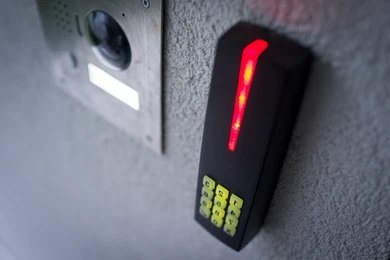
Intercom Systems
A door entry system is the only lock with forty owners
Every other job we do has one customer and one door. A communal entry system has a freeholder who owns it, a managing agent who maintains it, leaseholders who pay for it through the service charge, tenants who use it daily and never see a bill, and a postman who needs to get in twice a day. The hardware is the simple part. Working out who can authorise the work, and who pays, is very often the longer conversation.
It also fails differently to a lock. Locks fail mechanically. Entry systems fail socially. Fobs stay live for people who moved out in 2019. The trade code gets written on the frame in biro. Somebody wedges the door open for a delivery and it never quite shuts again because the closer has been fighting a dropped hinge for a year. A system can be in perfect electrical order and still be letting anybody in who wants to walk up to it.
None of which means the technology does not matter, only that it should be chosen around how the building actually runs. A block where half the flats are let short-term needs fobs that can be cancelled individually. A leaseholder who cannot get cable through a listed hallway needs a system that calls a mobile instead. A door that gets propped every morning needs the closer and the alignment sorted before anybody spends money on a new panel.
How We Approach a Door Entry System
Most entry systems we are called to are not broken so much as unmanaged. Cancelling dead fobs, sorting the door closer and fixing the alignment often does more than a new panel would.
Who Owns the Door, and Who Pays
On a communal entrance the answer is almost never the resident standing in front of it. The system belongs to the freeholder, the managing agent instructs the work, and the cost usually reaches leaseholders through the service charge. We are happy to attend, diagnose and put the findings in writing so a resident has something concrete to send to their agent, which tends to move things along faster than a description at an AGM. For a single flat door, none of that applies and you can simply book it.
Master Keys for BuildingsFobs, Codes and People Who Left
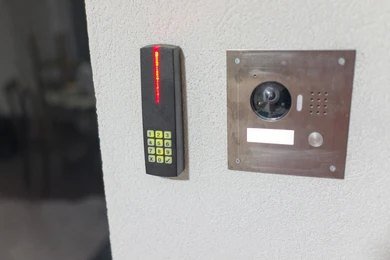
Proximity fobs are only useful if somebody manages the list. Most blocks we attend have more live fobs than residents, because nothing is ever cancelled when a tenancy ends. Deleting a lost or unreturned fob takes seconds and costs nothing, and it is the single cheapest security improvement available to a block. Shared keypad codes are the other weak point: a code known to every delivery driver in the postcode is not access control, it is a formality.
Changing Locks Between TenanciesVideo and GSM Without Rewiring
Where cabling is difficult, and in a converted period house it usually is, a GSM intercom answers the problem neatly by calling a mobile instead of a handset on the wall. Residents answer from anywhere, there is nothing to run through a listed hallway, and there is no handset to break. Video panels are worth the extra where a door is often answered to strangers. Both can usually go onto an existing door release rather than replacing the whole installation.
Cameras on the EntranceWhy the System Is Only Half the Job
- Findings put in writing for your agent — a resident with a written diagnosis gets a communal repair authorised far faster than one describing a buzzing noise.
- Fob lists audited, not just added to — we cancel what should not be live rather than only issuing new ones, because that is where the security actually sits.
- The door itself checked first — a closer that no longer shuts the door makes the finest entry panel in London completely irrelevant.
- 180-day warranty on locks, lifetime on keys — on the hardware we supply and fit, itemised for the freeholder or the service charge account.
Our Process - What Happens When You Call
- Tell us whether it is your flat or the building. A handset inside your own flat is yours to sort today. Anything at the communal door needs the freeholder or agent, and we will say so straight away.
- Describe what happens when somebody buzzes. No sound at all, ringing but no release, releasing but the door not opening, or working for some flats and not others. Each points somewhere different.
- Diagnosed at the panel and at the door. We test the panel, the release, the closer and the alignment, because two of those four are usually involved.
- Repaired, programmed and documented. Fobs issued and cancelled with a record of what is live, the door tested repeatedly, and the work itemised for whoever is paying.
Why Choose N1 Locksmiths?
You speak to the person doing the job
Describe the system once and the right handsets, fobs and release parts are on the van before it leaves Holloway Road.
Priced on the call where we can
A single handset, a panel repair and a full system replacement are very different jobs, and you hear which is likely before anyone travels.
Repair quoted before replacement
Older systems are often perfectly repairable. We will price the repair alongside the new system rather than quietly assuming you want the new one.
180-day warranty on locks, lifetime on keys
Hardware guaranteed and itemised, which matters when a managing agent has to approve the invoice.
Fob records handed over
You get a list of what is live at the end, because a block that cannot say how many fobs exist does not really have access control.
15–30 minutes across N and NW
Worked from Holloway Road, so a communal door stuck open is not left that way through the night.

Say whether it is your flat or the building
That one sentence saves everybody a great deal of time. A handset inside your own flat, or an intercom on a house you own, is yours to book today and often a short visit. Anything at a shared communal entrance belongs to the freeholder, and the most useful thing we can do is attend, diagnose it properly and give you something in writing to send to the managing agent. Tell us which situation you are in, roughly how many flats the system serves and what happens when somebody presses the button, and you will get a realistic answer before anybody travels — typically within 15–30 minutes across the N and NW postcodes.
Message on WhatsAppCALL 020 7129 7496Explore Our Locksmith Services
Communal entrances rarely need only one thing doing. These are the services most often specified alongside door entry — cameras covering the shared doorway, a master key suite so one key reaches every part of the building, and the flat doors behind the entrance brought up to standard.
Areas We Cover Across London
We work on door entry and intercom systems across N1 to N22 and NW1 to NW11 from 37 Holloway Road in N7, and no service we offer is more tied to the local housing stock than this one. Islington, Canonbury, Barnsbury, Highbury and Newington Green are dense with Victorian houses converted into three, four or five flats, each with a shared front door, an entry panel added decades after the building went up and cabling threaded wherever it would fit. Mansion blocks around Caledonian Road, Holloway and Kentish Town are the other pattern — larger systems, managing agents rather than freeholders in person, and doors taking hundreds of movements a day, where the closer and the alignment matter as much as the electronics.
FAQs – Intercom Systems
My handset does not work but my neighbours' do. Whose problem is that?
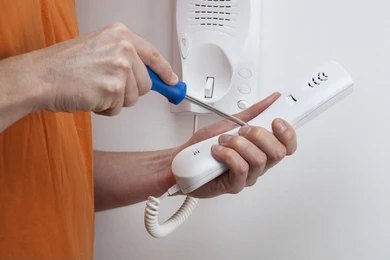
Almost certainly yours alone and usually a quick fix. A single dead handset points at the unit itself or the wiring into your flat rather than at the communal panel, which means you can book it directly without involving the agent. If several flats are affected at once, that changes it into a communal fault and a different conversation about who authorises the work.
Who pays for repairs to a communal entry system?
Ordinarily the freeholder arranges it and the cost reaches leaseholders through the service charge, though your lease is what actually decides it. As a resident you cannot usually instruct communal works yourself. What you can do is get the fault properly diagnosed and put in writing, which is often what turns a stalled complaint into an approved job.
Can I upgrade the intercom in my own flat without changing the whole system?
Often yes. Handsets can frequently be swapped for a newer or louder unit, or one with a video screen, while the communal panel and wiring stay exactly as they are. Compatibility depends on the system, so it is worth photographing the make and model on your existing handset before you call.
Can an intercom call my mobile instead of a handset on the wall?
Yes, and GSM intercoms are one of the more useful things we fit. The panel calls your phone, so you can answer the door and release it from anywhere, and there is no cabling to run through the building. They suit converted houses and listed buildings particularly well, and they remove the handset as a thing that can break.
Is video entry worth the extra over audio?
It depends who answers the door. For a household that regularly gets unexpected callers, or anyone who would rather see a stranger before letting them into a shared hallway, it is money well spent. For a small block of neighbours who all know each other, audio and a working door closer will usually serve you better than a screen.
Old tenants still have fobs. Can they be cancelled?
Yes, individually, and it takes seconds on most modern systems. This is the single cheapest security improvement available to a block, and it is almost never done. Every unreturned fob from every tenancy since the system went in is probably still live. We can audit the list, cancel what should not be there and give you a record of what remains.
Is a keypad code as good as a fob?
No, and it degrades over time in a way fobs do not. A code gets shared with a delivery driver, then written inside the porch, and within a year it is known to half the street. Codes suit a trade button on a timer far better than they suit resident access. Where a block insists on one, it should be changed on a schedule rather than left for years.
The door does not shut properly and people prop it open. Can you help?
Yes, and it is usually the most valuable thing we do on a block. A door that needs a shove to latch will get wedged, and a wedged communal door defeats every lock, fob and camera in the building. Adjusting the closer, the hinges and the keep so the door shuts under its own weight is a modest job with a disproportionate effect.
Does the door release automatically if the fire alarm goes off?
Where an electromagnetic lock is fitted to an escape route it should release on alarm activation and there should be a manual release too, which is why maglocks are wired into the fire alarm rather than installed in isolation. This falls under the building's fire risk assessment rather than under us, so for a communal block we will tell you what is fitted and refer the arrangement to the responsible person or your fire officer.
Our system is decades old. Repair it or replace it?
Repair is worth pricing first. Older audio systems are frequently still supported, and a panel refurbishment with a few new handsets costs a fraction of a full replacement. Where a system is genuinely obsolete and parts have dried up, we will say so plainly, because patching something unobtainable just moves the same conversation to next year.
How is intercom work priced?
By what it turns out to be, quoted before we travel where the fault is clear enough to price. A single handset or a fob programming visit is a small job. A panel replacement or a full system across a block is quoted in writing after a survey, itemised so a managing agent can approve it without a second conversation.