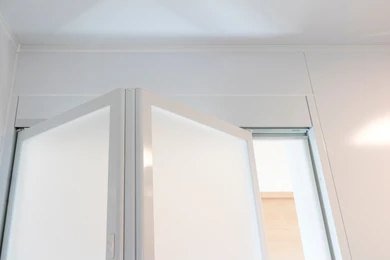
Bi-folding Doors

A bi-fold is not one door. It is five doors that have to agree

That distinction explains almost everything that goes wrong with them. A front door has one leaf, two hinges and one lock, and it either works or it does not. A bi-folding run has three, five or seven leaves, each hinged to the next, each carrying its own rollers or guides, with shootbolts dropping into the head and the threshold and a single handle expected to hold the whole assembly shut. Every one of those joints has a tolerance of a millimetre or two, and tolerances add up.

So the fault is very often nowhere near where you feel it. A run that catches at the far end is usually being caused by the leaf nearest the hinge post sitting fractionally proud. A shootbolt that will not drop into the floor is rarely a broken shootbolt; it is the leaf above it hanging a couple of millimetres low. Adjusting the leaf that is misbehaving is the instinctive move and it is normally the wrong one, because you end up chasing the error along the run.

The other thing worth knowing is that bi-folds are less forgiving of the building than any other door. A run can be four or five metres wide, and it hangs from a track that has to stay genuinely level. New-build settlement, a lintel taking up load over a year or two, or a screed that has moved will all show up in a bi-fold long before you would notice them anywhere else in the house. The door is often the first thing to report a problem that is not really the door's fault.

How We Get a Bi-Fold Closing Again

On a bi-fold, the leaf that misbehaves is seldom the leaf at fault. Errors accumulate along the run, so the fix usually starts at the hinge post rather than where you feel the problem.

Setting the Whole Run, Not One Leaf

We start at the hinge post and work outwards, checking each leaf against the next for height, plumb and the gap along the stile. Small corrections early in the run remove large problems at the far end, which is why chasing the leaf that catches almost never fixes it for long. Done properly the leaves fold with one hand, the gaps are even down every joint, and the handle engages without anybody pulling the run together.
Locksmith adjusting the leaves on a bi-folding door run in North LondonSliding Patio Doors

The Traffic Leaf Does All the Work

Almost every run has one leaf used as an ordinary door, opened several times a day while the rest stay folded for months. That leaf wears out first by a wide margin: its hinges loosen, its rollers flatten, its handle and lock take the load every single time. It is worth treating as a separate door for maintenance, and it is usually the one that needs a new lock or a set of hinges while the other four are still as fitted.
Worn traffic leaf on a bi-fold door being repaired in North LondonuPVC and Composite Doors

Shootbolts, Guides and Locking the Run

Intermediate leaves are held by shootbolts that drop into the head track and the threshold, and those are what actually secure a bi-fold rather than the handle. When one will not engage, the cause is nearly always alignment rather than the bolt, though worn top guides and blocked threshold sockets come up too. We clear and check every socket, because a run where only half the bolts engage is a run that is not locked.
Shootbolt and threshold socket on a bi-folding door being checked in North LondonIf the Mechanism Has Failed

Why We Set the Whole Run, Not One Leaf

  • We adjust from the hinge post outwards — correcting the run in order, rather than winding the one leaf that happens to be catching.
  • Every shootbolt socket cleared and tested — a run where two of five bolts engage feels locked from inside and is not.
  • We will say when it is the building — settlement and lintel deflection show up in a bi-fold first, and no amount of adjustment fixes a track that is no longer level.
  • 180-day warranty on locks, lifetime on keys — with the system and the parts named on the invoice, which matters on hardware that is brand-specific.

Our Process - What Happens When You Call

  1. Tell us how many leaves and which way they fold. Three, five or seven, folding left, right or split. It decides what we bring and how long the visit needs to be.
  2. Say where it catches and where it started. Bi-folds get worse gradually. Knowing whether it began at one end or appeared after a hot spell tells us a great deal before we arrive.
  3. Checked in order along the run. Each leaf measured against the next for height, plumb and gap, so we correct the cause rather than the symptom.
  4. Folded and locked repeatedly before we finish. The run opened and closed fully several times, every shootbolt tested into its socket, and the handle checked from both sides.

Why Choose N1 Locksmiths?

You speak to the person doing the job

Describe the run once and the right hinges, guides and shootbolt parts are on the van before it leaves Holloway Road.

Priced on the call, before we travel

An adjustment across a run, a traffic-leaf lock and a set of rollers are very different jobs, and you hear which is likely up front.

Brand-specific parts identified properly

Bi-fold hardware is not interchangeable between systems, so we identify what you have before ordering anything rather than after.

180-day warranty on locks, lifetime on keys

Everything we fit is guaranteed and named on the invoice, which matters when the same system needs parts again.

Honest when it is not the door

If the opening has moved, we will tell you, because adjusting leaves to compensate for a dropped lintel only postpones it.

15–30 minutes across N and NW

Worked from Holloway Road, so a run that will not close properly is not left open to the garden overnight.

N1 Locksmiths engineer aligning a bi-folding door run in North London
Bi-folding Doors

Count the leaves before you call

Three numbers make this job far easier to price accurately in advance: how many leaves the run has, which direction they fold, and whether the problem is at the hinge end, the far end or in the middle. If you can also say roughly when it started and whether it came on gradually or after a hot spell, we can usually tell you on the phone whether you are looking at an adjustment, a hardware replacement or something structural — with an engineer reaching you within 15–30 minutes across the N and NW postcodes.

Message on WhatsAppCALL 020 7129 7496

Explore Our Locksmith Services

A bi-fold is usually one of several doors onto the same garden. These are the jobs most often booked alongside it — a sliding door that has dropped onto worn rollers, a side door realigned, or the traffic leaf and back door brought onto a single key.

Areas We Cover Across London

We work on bi-folding doors across N1 to N22 and NW1 to NW11 from 37 Holloway Road in N7, and this service follows the rear extensions rather than the postcodes. The side-return and full-width extensions built across Canonbury, Highbury, Barnsbury and Islington over the last fifteen years almost all finished with an aluminium bi-fold onto the garden, and many of those runs are now old enough to need their first proper service. Larger houses towards Hampstead, Golders Green, Finchley and the NW11 roads tend to have wider runs of five or seven leaves, where cumulative error matters more and where structural settlement in a new opening is the most common reason a run that worked beautifully for two years suddenly does not.

FAQs – Bi-folding Doors

My bi-fold catches at one end. Why does adjusting that leaf not fix it?

Because the error almost certainly starts further back along the run. Each leaf is hinged to the next, so a couple of millimetres at the hinge post becomes a visible bind five leaves later. Adjusting the leaf that catches shifts the problem rather than removing it, which is why we work outwards from the hinge post instead.

One of the shootbolts will not drop into the floor. Is it broken?

Usually not. A shootbolt that will not engage is nearly always telling you the leaf it sits in is hanging slightly low or slightly out of plumb, so the bolt is arriving off-centre of its socket. Blocked or silted threshold sockets are the other common cause. Genuinely broken shootbolts do happen, but they are the minority.

The doors have become really heavy to fold. What causes that?

Flattened rollers or top guides, debris in the track, or the run being out of alignment so the leaves are dragging against each other rather than swinging freely. On a wide run the weight is considerable, so small amounts of friction feel like a lot. It is worth sorting early, because forcing a heavy run is what loosens hinges.

Only one of my doors is used day to day. Does that matter?

It matters more than people expect. That traffic leaf gets opened several times a day while the rest stay folded for months, so it wears at a completely different rate. Its hinges loosen, its lock takes all the load and its rollers flatten first. We treat it as a separate door, and it is often the only leaf that needs anything.

My bi-fold worked perfectly and now it does not close. Nothing has changed.

Something has, but probably not in the door. Bi-folds are the most sensitive thing in a house to structural movement, because the run is wide and the track has to stay level. New-build settlement, a lintel taking up load, or a screed that has moved will show up here first. We check whether the opening is still square before we start adjusting leaves.

Are bi-folding doors secure?

A well-adjusted modern run with all its shootbolts engaging is secure, and the multiple bolts into head and threshold are genuinely strong. The risk is a run that has drifted out of alignment, because the handle still feels locked while only some of the bolts have actually engaged. That is the single most useful thing to have checked.

Do you work on aluminium bi-folds as well as uPVC?

Yes, and most of what we see is aluminium, since that is what the majority of rear extensions were fitted with. Aluminium runs are heavier and use system-specific hinges, rollers and shootbolt gear that vary between manufacturers, so identifying the system correctly matters before any part is ordered.

Can a single leaf be repaired or replaced on its own?

Hardware, yes — hinges, rollers, guides, handles and locks are all replaceable leaf by leaf, which is the usual repair. Replacing an entire leaf including its glass is a different proposition and depends on the system still being supported by its manufacturer. We will tell you which situation you are in before you commit to anything.

Should the track be cleaned, and how often?

Yes, and more often than most people do it. The bottom track sits at floor level onto a garden or terrace, so it collects grit and leaf debris that grinds into rollers and blocks shootbolt sockets. Brushing and vacuuming it out a couple of times a year costs nothing and prevents a good proportion of the faults on this page.

How long does a bi-fold repair take?

Adjusting and setting a run is usually one to two hours, because it is done leaf by leaf and then tested repeatedly. Hardware replacement on a single leaf is quicker. Where parts have to be identified and ordered for a particular system, we do the diagnosis on the first visit and fit on the second, and you will know that before we start.

How is bi-fold work priced?

By the size of the run and what it actually needs. An adjustment across a three-leaf run and a hardware replacement on a seven-leaf aluminium system are quite different pieces of work. Tell us how many leaves you have, which way they fold and what the run is doing, and you will have a realistic figure before anybody travels.

Trusted Bi-folding Door Services You Can Rely On

Set from the hinge post outwards, every shootbolt tested into its socket, brand-specific parts identified before they are ordered, and an honest answer when the opening rather than the door has moved.

Call NowBook Now